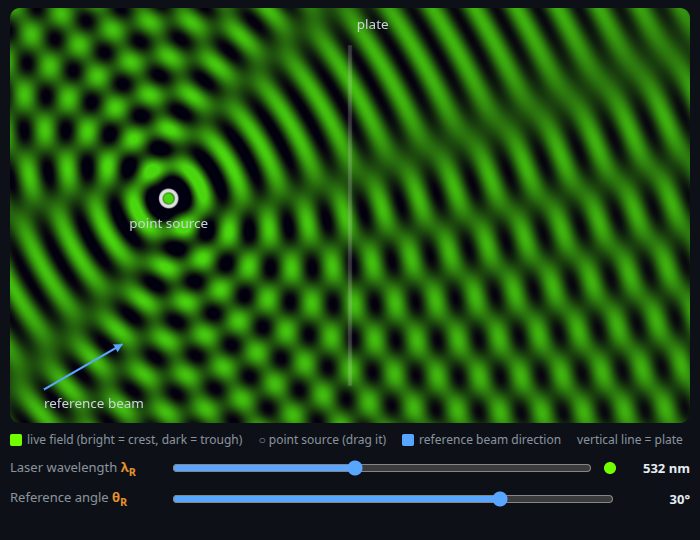
Hold up a real object and look at it. Each eye catches the light coming from every visible point, each ray arriving at its own angle — and the brain reads those angles, and the way they shift as you move, as solid depth. The object never reaches you; only the light it sends does. So if a flat surface could emit exactly that light — the same rays, in the same directions, at the same brightness — an eye in front of it would see the object in full depth, with nothing there. That is the aim of holography.
This is an interactive article on how that works: how the interference of an object wave and a tilted reference wave writes a diffraction grating into a plate, and how illuminating that grating reconstructs the recorded wave. Every figure below is a live 2D wave-optics simulation — change the wavelength, tilt, coherence, or replay source and watch the field, the exposure, and the reconstruction respond in real time.
It runs full-screen best; the embedded version below is the same article.
The interactive article is open-source at github.com/mczielinski/holography-tutorials. Updates pushed there appear here automatically.